
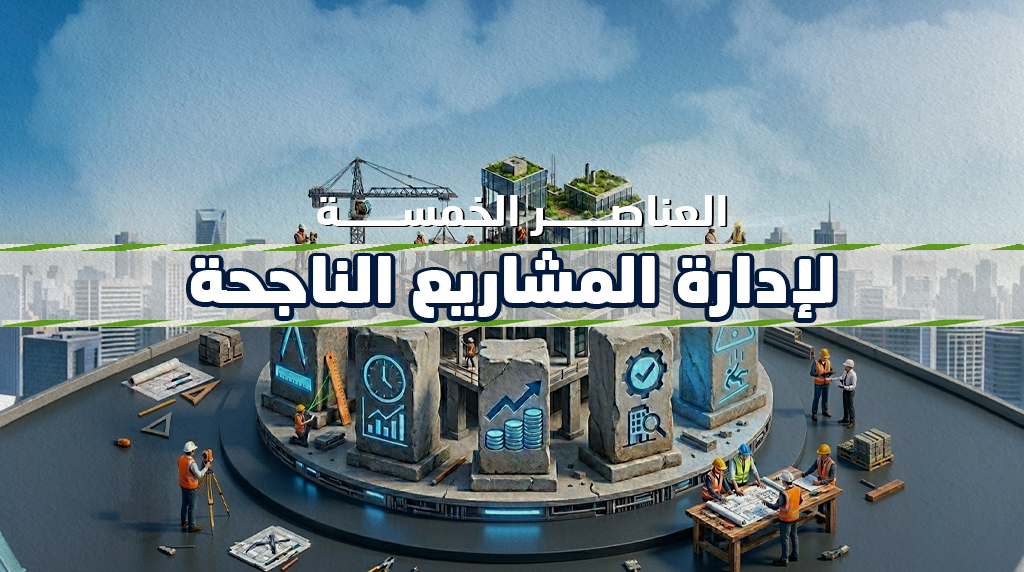
The Five Elements of Successful Engineering Project Management
Why Do Some Projects Succeed While Others Struggle?
In the construction industry, it is common to see projects that begin with substantial budgets, qualified teams, and well-developed plans, yet still experience delays, cost overruns, or quality issues. At the same time, other projects achieve their objectives despite facing significant technical and operational challenges.
The difference is rarely due to engineering expertise alone. More often, it is the result of how effectively the project is managed from the very beginning. Successful projects are not built on luck or reactive decision-making; they are built on a structured management framework that controls every critical aspect of the project throughout its lifecycle.
According to globally recognized project management methodologies such as the PMBOK® Guide published by the Project Management Institute (PMI), project success depends on maintaining a balance between five key elements: scope, time, cost, quality, and risk.
These elements form the foundation that determines a project’s ability to achieve its technical, financial, and operational objectives.
What Is Engineering Project Management?
Engineering project management is the process of planning, organizing, directing, and controlling resources and activities required to deliver an engineering project within a defined scope, schedule, budget, and quality standard.
Many young engineers assume that project management is limited to site supervision and construction monitoring. In reality, a project manager’s role begins long before construction starts and continues until the project is formally completed and handed over.
The Engineering Project Lifecycle
Most engineering projects progress through five primary phases:
1. Initiation
This phase involves defining project objectives, evaluating feasibility, and identifying key stakeholders.
2. Planning
One of the most critical stages, where schedules, budgets, quality plans, and risk management strategies are developed.
3. Execution
The phase where construction activities take place and resources, contractors, and suppliers are coordinated.
4. Monitoring and Control
Project performance is measured against the plan, and corrective actions are implemented when necessary.
5. Closing
The project is formally handed over, contracts are closed, and lessons learned are documented.

Element One: Scope Management
Scope management is one of the most important factors influencing project success. Any ambiguity regarding project requirements can lead to contractual disputes, delays, and cost overruns.
What Is Project Scope?
Project scope defines all the work required to achieve the project’s objectives, as well as the work that falls outside the project’s responsibilities.
In simple terms, scope answers two critical questions:
- What will be delivered?
- What will not be delivered?
The clearer the answers, the lower the risk of misunderstandings and disputes during execution.
Key Components of Project Scope
Project scope typically includes the following elements:
Scope Statement
A detailed document describing the work required to complete the project.
Deliverables
The products, services, or outcomes that must be delivered to the client.
Assumptions
Factors assumed to be true during planning.
Constraints
Limitations that may affect project execution, such as budget, schedule, or resource restrictions.
The Importance of Work Breakdown Structure (WBS)
The Work Breakdown Structure (WBS) is one of the most important tools in project management.
It breaks the project into smaller, manageable work packages that can be assigned, monitored, and controlled effectively.
A well-developed WBS helps:
- Define responsibilities clearly.
- Improve cost and schedule estimates.
- Simplify progress monitoring.
- Reduce the risk of overlooking project activities.
What Is Scope Creep?
Scope Creep refers to uncontrolled expansion of project scope after execution has begun without corresponding adjustments to budget or schedule.
It is widely recognized as one of the most common causes of project failure.
For example, a client may request additional work during construction without issuing formal change orders or revising the project timeline, creating pressure on resources and increasing both cost and schedule risk.
Best Practices for Scope Management
- Document all requirements from the beginning.
- Review scope with all stakeholders.
- Establish a formal change management process.
- Update the budget and schedule whenever approved changes occur.
Engineering Insight
A significant portion of contractual disputes in construction projects can be traced back to poorly defined scopes of work or ineffective management of change orders.
Element Two: Time Management
Time is one of the most sensitive resources in engineering projects. Delays in critical activities can create a chain reaction that affects cost, productivity, and client satisfaction.
How Is a Project Schedule Developed?
Project scheduling typically begins with:
Activity Identification
Defining all tasks required to complete the project.
Activity Sequencing
Establishing logical relationships between activities.
Duration Estimation
Determining the time required to complete each activity based on available resources.
Schedule Development
Creating the final schedule using tools such as Primavera P6 or Microsoft Project.
What Is the Critical Path Method (CPM)?
The Critical Path Method is one of the most important concepts every project engineer should understand.
It can be defined as:
“The longest sequence of dependent activities that determines the minimum time required to complete the project.”
Any delay in a critical path activity directly delays the project completion date.
Non-critical activities may have schedule flexibility known as Float, allowing limited delays without affecting the final completion date.
Common Causes of Construction Delays
Procurement Delays
Late delivery of materials and equipment.
Design Changes
Frequent revisions to drawings and specifications during construction.
Poor Coordination
Insufficient communication between project disciplines.
Resource Shortages
Lack of labor, equipment, or essential materials.
External Factors
Weather conditions, regulatory approvals, and unforeseen site conditions.
Key Schedule Performance Indicators
Planned Progress
The percentage of work expected to be completed according to the schedule.
Actual Progress
The percentage of work actually completed.
Schedule Performance Index (SPI)
A metric used to evaluate schedule efficiency compared to the baseline plan.
- SPI greater than 1 indicates performance ahead of schedule.
- SPI equal to 1 indicates performance on schedule.
- SPI less than 1 indicates schedule delays.
Engineering Insight
Not every activity in a schedule is critical, but any delay on the critical path will directly impact the project’s completion date.
Element Three: Cost Management
Cost management is one of the most important indicators of project success. Delivering a technically successful project while exceeding the approved budget often reflects weaknesses in planning or financial control.
Cost management extends far beyond preparing initial estimates. It includes monitoring actual expenditures throughout the project lifecycle and taking corrective action when deviations occur.
Cost Estimation vs. Cost Control
Many engineers confuse these two concepts despite their distinct purposes.
Cost Estimation
The process of predicting project costs before execution based on drawings, specifications, quantities, and market prices.
Cost Control
The process of monitoring actual expenditures and comparing them against the approved budget to prevent unnecessary overruns.
The Main Stages of Cost Management
1. Cost Estimation
Preparing preliminary and detailed project cost forecasts.
2. Budget Development
Converting estimates into an approved project budget.
3. Cost Control
Tracking expenditures, analyzing variances, and managing financial changes.
Earned Value Management (EVM)
Earned Value Management is one of the most powerful project performance measurement tools.
It compares:
- Planned Value (PV)
- Earned Value (EV)
- Actual Cost (AC)
This allows project teams to determine whether the project is performing according to both budget and schedule expectations.
Key Financial Performance Indicators
Cost Performance Index (CPI)
Measures cost efficiency.
- CPI greater than 1 indicates favorable cost performance.
- CPI equal to 1 indicates spending is exactly on budget.
- CPI less than 1 indicates budget overruns.
Cost Variance (CV)
Measures the difference between Earned Value and Actual Cost.
It helps identify financial problems early before they become critical.
How Early Financial Monitoring Improves Project Success
The earlier financial deviations are identified, the greater the opportunity to implement corrective actions and minimize losses.
Successful projects typically rely on regular reporting of:
- Progress percentages
- Cash flow
- Actual expenditures
- Forecasted project costs
Engineering Insight
Modern project management practices focus not only on construction costs but also on the total lifecycle cost of the asset, including future operations and maintenance.
Element Four: Quality Management
Quality is not a phase that occurs at the end of a project; it is an ongoing process that begins during planning and continues until final handover.
In construction projects, poor quality can result in rework, schedule delays, increased costs, and dissatisfied clients.
Quality Assurance vs. Quality Control
This is one of the most misunderstood concepts among young engineers.
Quality Assurance (QA)
Focuses on preventing defects through processes, procedures, and systems.
Examples include:
- Quality planning
- Procedure reviews
- Method statement approvals
Quality Control (QC)
Focuses on inspecting completed work and identifying defects.
Examples include:
- Concrete testing
- Material inspections
- Site inspections
Simply put:
QA prevents defects.
QC detects defects.
The Importance of a Project Quality Plan
A Project Quality Plan establishes the standards and procedures that will be followed throughout the project.
It typically includes:
- Inspection and testing requirements
- Acceptance criteria
- Roles and responsibilities
- Documentation procedures
Inspection and Testing in Construction Projects
Modern construction projects rely on various inspection and testing activities, including:
Material Inspection
Verifying compliance with specifications.
Concrete Testing
Including compressive strength testing and slump testing.
Technical Audits
Reviewing compliance with drawings, procedures, and standards.
The Cost of Quality vs. The Cost of Rework
Industry experience consistently shows that correcting defects after construction is significantly more expensive than preventing them during execution.
Rework can negatively impact:
- Schedule
- Budget
- Safety
- Client satisfaction
Engineering Insight
The cost of preventing defects is almost always lower than the cost of correcting them after construction is completed.
Element Five: Risk Management
No engineering project is completely free of risk.
What separates successful projects from struggling ones is how risks are identified, assessed, and managed before they occur.
Risk management does not eliminate all risks; it prepares the project team to minimize their impact.
What Is Project Risk?
Risk refers to uncertain events or conditions that may affect project objectives either positively or negatively.
In construction projects, risk management typically focuses on mitigating potential negative impacts.
Major Types of Project Risks
Technical Risks
Design errors, unforeseen ground conditions, or technical failures.
Financial Risks
Material price fluctuations and currency exchange variations.
Contractual Risks
Disputes, claims, and delayed approvals.
Safety Risks
Accidents and occupational hazards.
Supply Chain Risks
Procurement delays and material shortages.
Risk Register
The Risk Register is one of the most important project management documents.
It typically includes:
- Risk description
- Probability
- Impact
- Risk owner
- Response strategy
Risk Matrix
A Risk Matrix is used to prioritize risks based on:
- Probability
- Impact
Risks with high probability and high impact require immediate attention and mitigation planning.
Risk Response Strategies
Avoid
Eliminate the risk entirely.
Mitigate
Reduce either the likelihood or impact of the risk.
Transfer
Shift part of the risk to another party, such as through insurance or subcontracting.
Accept
Acknowledge the risk and prepare contingency plans.
Engineering Insight
Effective risk management begins during planning, not when problems arise during construction.
How the Five Elements Work Together
Although each element can be analyzed separately, they are highly interconnected in practice.
For example, when project scope changes during construction:
- Schedule duration increases.
- Project costs rise.
- Additional risks emerge.
- Quality requirements become more difficult to maintain.
For this reason, project success depends on balancing scope, time, cost, quality, and risk throughout the project lifecycle.
The Atwar Alkon Approach to Engineering Project Management
At Atwar Alkon, we believe successful projects are built through disciplined planning and professional management.
Every project begins with five fundamental principles:
- Scope: We clearly define what will and will not be delivered.
- Time: We develop realistic and achievable schedules.
- Cost: We maintain transparent budgets with no surprises.
- Quality: We adhere to strict standards throughout every phase.
- Risk: We prepare for the worst to ensure the best outcomes.
“This is our management approach… and this is Atwar Alkon.”
Essential Skills for Successful Project Engineers
In addition to technical knowledge, successful project engineers require a combination of management and analytical skills, including:
- Contract and specification review
- Schedule development and monitoring
- Risk management
- Cost control
- Technical reporting
- Stakeholder communication
- Primavera P6 and Microsoft Project proficiency
- Data analysis and decision-making
As construction projects become increasingly complex, these skills have become critical for long-term professional success.
Conclusion
Successful engineering projects are not driven by technical expertise alone. They depend on a balanced framework of planning, management, and control. Managing scope, time, cost, quality, and risk effectively is essential to delivering projects that meet stakeholder expectations.
As modern construction projects continue to grow in complexity, engineering project management has become a strategic discipline that is just as important as design and execution.
Investing in professional project management is not an additional cost—it is one of the most important drivers of project success, sustainability, and long-term value.
Frequently Asked Questions (FAQ)
What is engineering project management?
Engineering project management is the process of planning, organizing, and controlling resources and activities to deliver an engineering project within defined scope, schedule, budget, and quality requirements.
What are the five key elements of successful engineering projects?
Scope management, time management, cost management, quality management, and risk management.
What is the Critical Path Method in project management?
It is the longest sequence of dependent activities that determines the minimum project completion duration.
What is the difference between Quality Assurance and Quality Control?
Quality Assurance focuses on preventing defects through processes and procedures, while Quality Control focuses on inspecting completed work and identifying defects.
How does risk management improve construction project success?
By identifying potential threats early and implementing response strategies that reduce their impact on schedule, cost, quality, and overall project performance.