Precast Concrete Beams: Benefits, Installation Process & Applications
Modern construction projects demand solutions that combine speed, quality, and structural reliability. Precast concrete beams have become one of the most efficient structural components for residential, commercial, industrial, and infrastructure developments. Manufactured under controlled factory conditions, these beams provide consistent quality while significantly reducing on-site construction time.
At Atwar Alkon, we provide professional precast concrete beam supply and installation services across Saudi Arabia, delivering engineered solutions that comply with the Saudi Building Code and international construction standards.
What Are Precast Concrete Beams?
Precast concrete beams are horizontal structural elements manufactured in specialized factories before being transported to the construction site for installation. Their primary function is to support loads from slabs, roofs, and walls and transfer those loads safely to columns or load-bearing walls.
Unlike cast-in-place beams, precast beams are produced in a controlled manufacturing environment, ensuring greater dimensional accuracy, consistent concrete quality, and improved structural performance.
They are widely used in projects where construction speed, quality control, and reduced on-site labor are critical.
How Are Precast Concrete Beams Manufactured?
The manufacturing process follows strict engineering procedures to ensure every beam meets the required structural specifications.
Typical production stages include:
- Preparing steel molds according to approved engineering drawings.
- Installing reinforcement steel or prestressing tendons where required.
- Casting high-strength concrete using controlled mix designs.
- Curing the concrete under controlled conditions to achieve the specified strength.
- Inspecting dimensions, concrete quality, and surface finish.
- Storing and transporting the beams safely to the construction site.
Factory production minimizes workmanship errors and delivers consistent quality compared with traditional cast-in-place construction.
Key Benefits of Precast Concrete Beams
Precast concrete beams offer several advantages that make them an increasingly popular construction solution.
Faster Construction
Since the beams are manufactured before arriving on site, installation can begin immediately, reducing overall project duration.
Superior Quality Control
Factory-controlled production ensures consistent concrete strength, accurate dimensions, and high-quality finishes.
Reduced On-Site Labor
Precast systems eliminate much of the formwork, reinforcement placement, and concrete casting typically required on site.
Improved Safety
Less on-site concrete work results in a cleaner and safer construction environment.
Cost Efficiency
Although initial manufacturing costs may vary, reduced labor requirements and shorter project schedules often lower overall construction costs.
Precast Concrete Beam Installation Process
Successful installation depends on proper planning and execution.
The typical installation process includes:
1. Structural Design Review
Engineering drawings are reviewed to verify beam sizes, lifting points, and support conditions.
2. Manufacturing
Beams are produced according to project specifications and quality standards.
3. Transportation
Specialized transport vehicles deliver the beams safely to the project site.
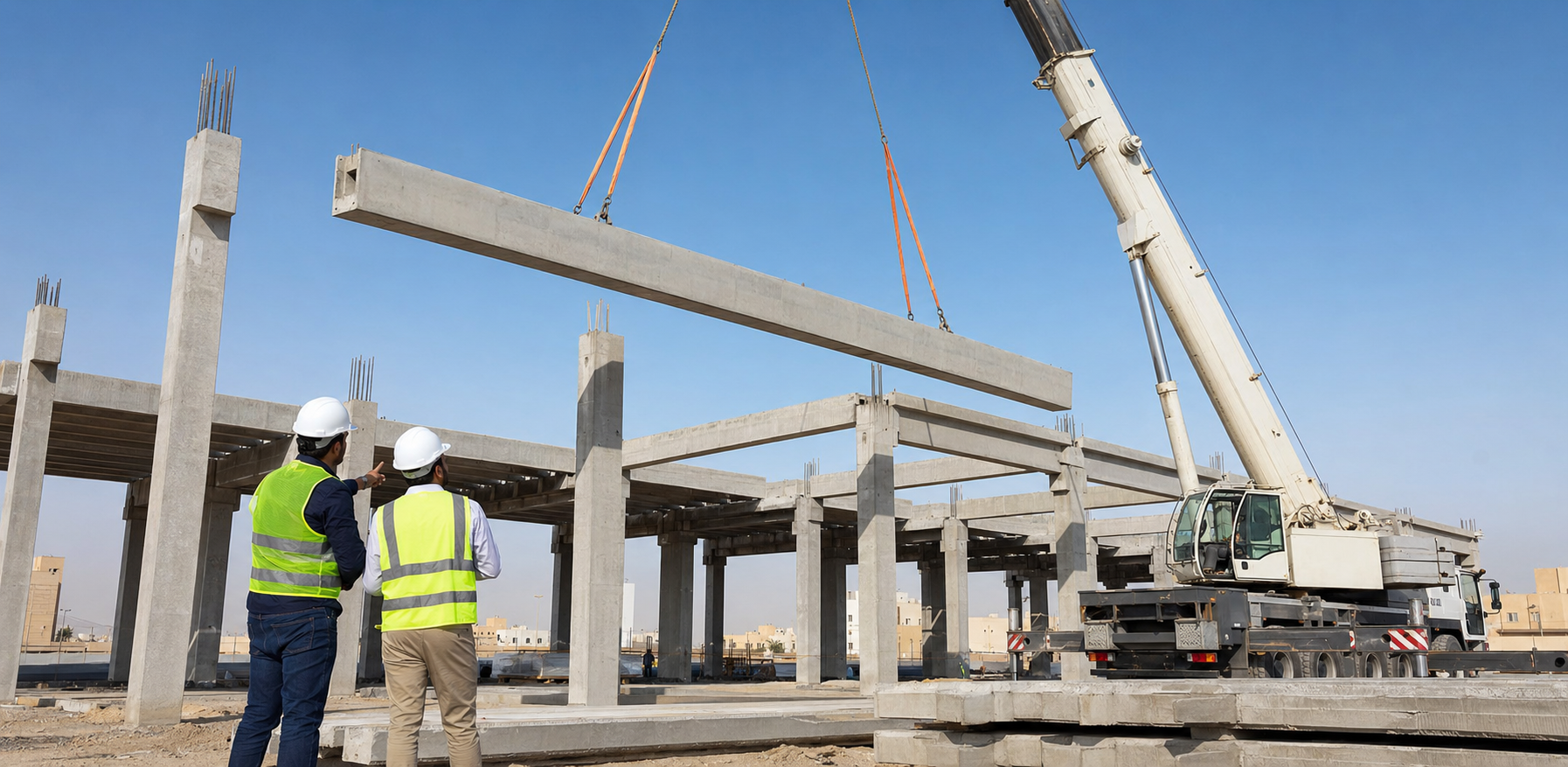
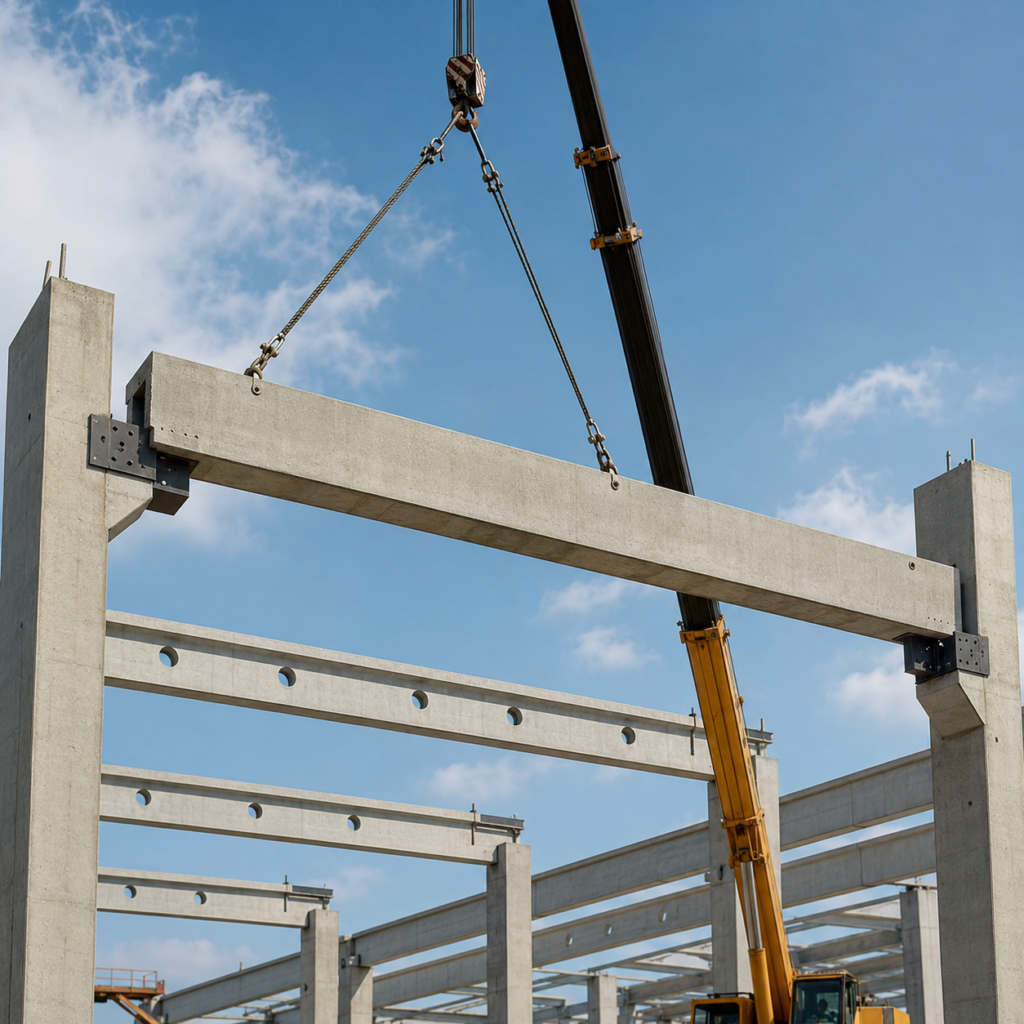
4. Lifting and Placement
Cranes position each beam accurately according to the structural layout.
5. Alignment and Leveling
Engineers verify beam alignment, elevations, and bearing locations before final fixing.
6. Connection Works
Structural connections, reinforcement continuity, and grouting are completed according to the design requirements.
7. Final Inspection
All installed beams are inspected before slab construction begins.
Common Applications of Precast Concrete Beams
Precast concrete beams are widely used in:
- Residential buildings
- Villas and housing developments
- Commercial buildings
- Office complexes
- Schools and universities
- Hospitals
- Industrial facilities
- Warehouses
- Government buildings
- Infrastructure projects
Their versatility makes them suitable for projects of various sizes and structural requirements.
Precast Concrete Beam Dimensions
There are no standard precast concrete beam dimensions suitable for every project.
Beam dimensions depend on several engineering factors, including:
- Span length
- Structural loads
- Building type
- Floor system
- Column layout
- Concrete strength
- Applicable building codes
Structural engineers determine the appropriate beam dimensions based on detailed structural analysis.
Precast vs. Cast-in-Place Concrete Beams
| Precast Concrete Beams | Cast-in-Place Concrete Beams |
| Manufactured in a factory | Constructed on site |
| Faster installation | Longer construction time |
| Consistent quality | Quality depends on site conditions |
| Minimal formwork required | Extensive formwork required |
| Reduced labor requirements | Higher on-site labor demand |
The most suitable solution depends on the project’s schedule, budget, and structural design requirements.
Choosing the Right Precast Concrete Beam Solution
Selecting the appropriate precast beam system requires consideration of:
- Building type
- Structural loads
- Span requirements
- Construction schedule
- Budget
- Roof or floor system
- Engineering specifications
Working with an experienced contractor ensures the most suitable structural solution for your project.
Why Choose Atwar Alkon?
At Atwar Alkon, we provide comprehensive precast concrete beam supply and installation services for residential, commercial, industrial, and infrastructure projects across Saudi Arabia.
Our services include:
- Structural engineering consultation
- Precast beam supply
- Transportation and logistics
- Crane lifting and installation
- Quality assurance inspections
- Compliance with the Saudi Building Code
- Complete project coordination
Our commitment to quality, safety, and timely delivery enables clients to complete projects efficiently while maintaining the highest engineering standards.
Frequently Asked Questions
What are precast concrete beams?
Precast concrete beams are structural beams manufactured in specialized factories and transported to construction sites for installation.
Are precast concrete beams stronger than cast-in-place beams?
Both systems can achieve excellent structural performance when properly designed. However, precast beams often provide more consistent quality due to controlled factory production.
Where are precast concrete beams commonly used?
They are widely used in residential, commercial, industrial, educational, healthcare, and infrastructure projects.
How are precast concrete beams installed?
They are transported to the site, lifted using cranes, positioned on their supports, connected according to the structural design, and inspected before further construction continues.
Conclusion
Precast concrete beams offer an efficient structural solution for projects that require speed, durability, and consistent quality. Their factory-controlled manufacturing process, combined with rapid on-site installation, helps reduce construction time while maintaining high structural performance.
At Atwar Alkon, we deliver professional precast concrete beam supply and installation services tailored to the needs of residential, commercial, and industrial projects throughout Saudi Arabia. To learn more about structural beam design and reinforcement, read our article “Concrete Beams: Types, Design, Reinforcement, and Their Role in Building Quality.” You can also explore our guide on “Block and Beam Flooring Systems” to understand how precast beams integrate with modern floor construction systems.